Data Warehouse/ETL Testing
Prove every row in your data warehouse
or lakehouse is right

QuerySurge validates 100% of your warehouse data from source to target, across every ETL transformation.
Tests are built with AI, run in your CI/CD pipeline, and leave an audit trail behind every load.
The program risk
Your warehouse is only as good as the data you can prove.
Every report, dashboard, and model downstream trusts what lands in the warehouse.
When an ETL defect slips through, the bad data doesn't announce itself. It shows up later as the wrong number for an executive, a regulator, or a customer.
And by then it's expensive to trace and harder to undo.
- $14M per year: Gartner's estimate of what bad data costs the average company, with some losing up to $100M.
- 14% of revenue: wasted by 75% of businesses due to poor data quality, per Experian Data Quality.
- Where warehouse programs feel it most:
- Huge data volumes that no one can check by hand
- Complex transformations and business rules
- Schema changes that quietly break loads
- No automation, so testing becomes the bottleneck at release time
Where validation sits
A validation layer for your whole warehouse pipeline.
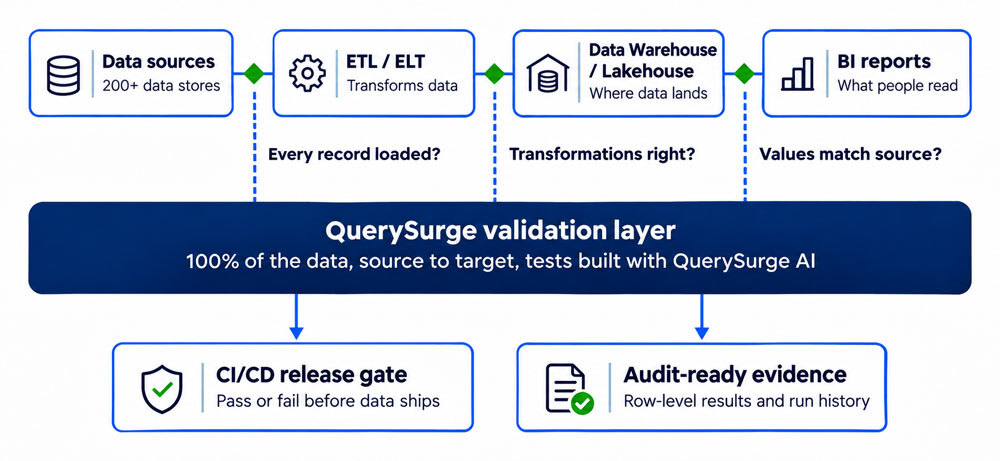
QuerySurge sits alongside your ETL tool, data warehouse/lakehouse, and BI layer. It checks the data at every handoff, gates releases in your pipeline, and keeps the evidence.
What gets proven
Every row, every transformation, source to target.
QuerySurge compares what left the source with what landed in the warehouse, applying your transformation logic and business rules.
It checks all the data, not a sample, and flags exactly which rows don't match.
What QuerySurge validates:
- Completeness: every record that should have loaded did.
- Transformations: calculations, mappings, and business rules produced the right result.
- Accuracy: values in the target match the source, row by row.
- Every source type: 200+ data stores, including data warehouses, databases, data lakes/lakehouses, NoSQL stores, flat files, Excel, XML, JSON, Parquet, APIs, CRMs and ERPs.
How tests get built:
QuerySurge AI uses generative AI to create validation tests, including transformation logic, with no coding required. Testers who prefer SQL can still write and tune their own.
Why the old ways fall short
Approach |
The Catch |
|---|---|
|
Sampling ("stare and compare") |
Checks under 1% of the data, slowly and by hand |
MINUS queries |
Inefficient, no reporting, no audit trail |
Homegrown tools |
Costly to build and keep up |
Third-party frameworks |
Vendor lock-in and limited flexibility |
QuerySurge |
100% of the data, automated, with a full audit trail |
The evidence you get
Proof you can show, not just a green checkmark.
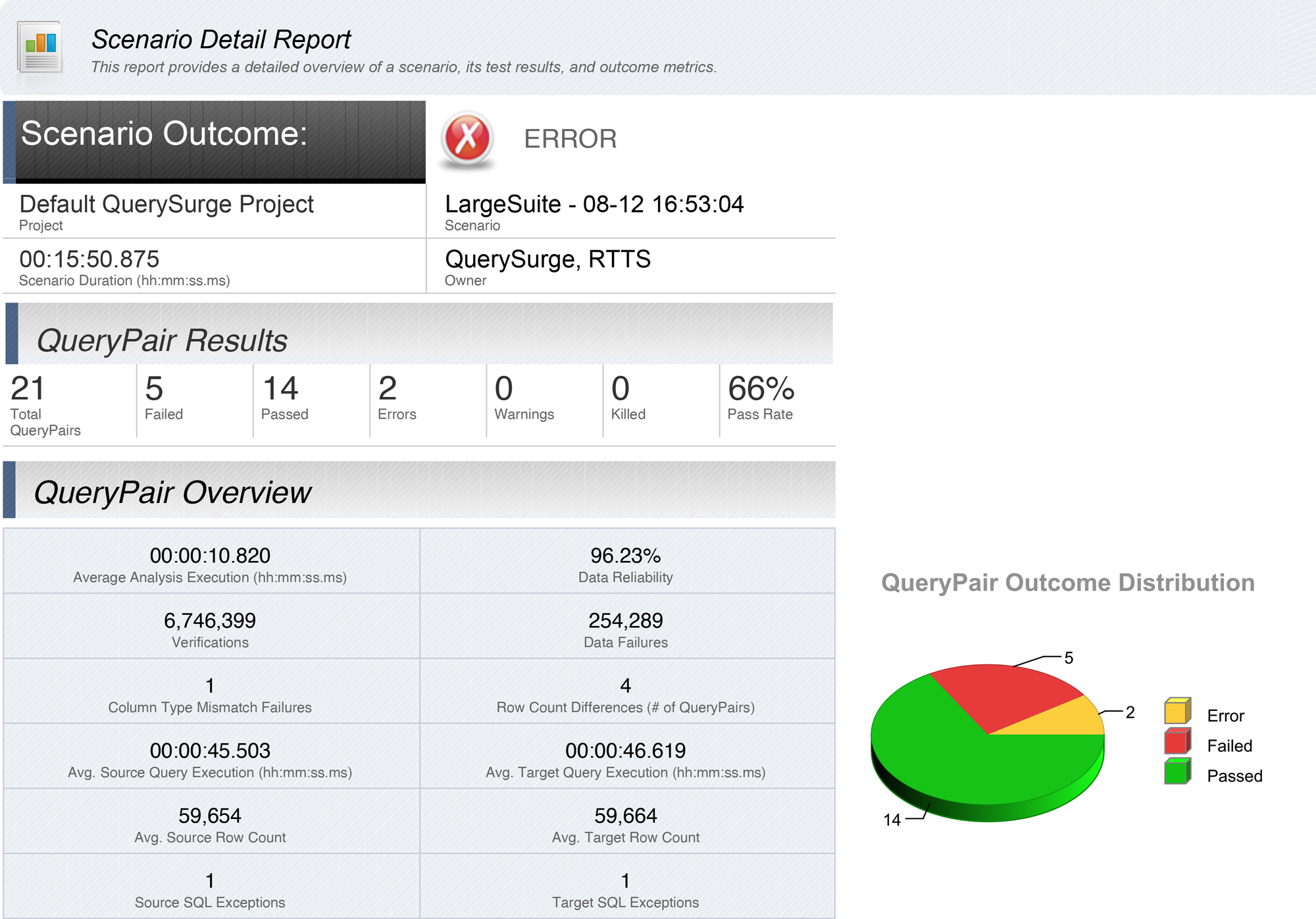
Every QuerySurge run leaves a record of what was checked, what passed, what failed, and which rows were wrong. That record is what turns "we tested it" into something an auditor, a data owner or a release manager can sign off on.
What's in the evidence
- Row-level results: the exact records that failed and why.
- Run history: every test, every load, every result, kept over time.
- Analytics dashboards and intelligence reports: trends in data quality across loads and releases.
- Automated alerts: the right people hear about failures right away.
Integrations with the rest of the stack
Plugs into the warehouse stack you already run.
QuerySurge doesn't replace your ETL tool, scheduler, or test management system. It works alongside them as the validation layer, connected through a RESTful API.
Stack Layer |
How QuerySurge Connects |
|---|---|
Data sources and targets |
200+ data store integrations, from warehouses to flat files and APIs |
ETL and ELT tools |
Kick off validation automatically after each load |
CI/CD pipelines |
Run tests as a pass/fail gate before data is released |
Test management systems |
Send results where your QA team already tracks work |
BI reports |
Validate the reports that sit on top of the warehouse (link to the BI Report Testing page) |
See the DevOps for Data page for API and pipeline details.
Design validation into your next warehouse program
See QuerySurge in action on your own data, or talk with our team about where it fits in your pipeline.
Data Warehouse/ETL Testing FAQs
(To expand the sections below, click on the +)
- What are the key challenges in ETL Testing?
- What is the difference between ETL Testing and Data Warehouse Testing?
- What are the different stages in ETL Testing?
- What tools are available for ETL Testing (manual and automated)?
- How does ETL Testing fit into CI/CD and DevOps pipelines?
What are the key challenges in ETL Testing?
Large data volumes, complex transformations, schema changes, poor data quality, and a lack of automation.
What is the difference between ETL Testing and Data Warehouse Testing?
ETL Testing focuses on validating pipelines; Data Warehouse Testing also covers reporting, metadata, and BI validation.
What are the different stages in ETL Testing?
Requirement analysis, test planning, test design, test execution, defect logging, and reporting.
What tools are available for ETL Testing (manual and automated)?
Manual SQL scripts, Python frameworks, or automated tools like QuerySurge, Informatica DVO, Talend, and RightData.
How does ETL Testing fit into CI/CD and DevOps pipelines?
ETL Testing runs automatically as part of deployments, enforcing data quality gates.