Whitepaper
Industrializing Data Correctness through AI:
A Strategic Analysis of QuerySurge AI as
The Engine of Enterprise Data Integrity
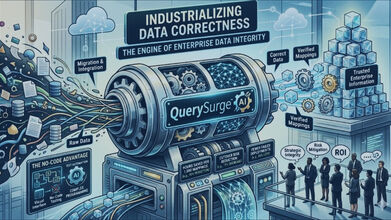
The Imperative of Data Industrialization in Modern Enterprise
The contemporary global economy is increasingly predicated on the precision and availability of data. As organizations transition from traditional business models to data-driven enterprises, the integrity of the underlying information assets becomes the primary determinant of competitive advantage. However, this transition is occurring against a backdrop of unprecedented architectural complexity.
The shift from centralized data warehouses to distributed data meshes, cloud-native data lakehouses, and hybrid multi-cloud environments has created a landscape where data is constantly in motion, undergoing myriad transformations across complex Extract, Transform, Load (ETL) pipelines.1 In this environment, the traditional methods of data validation—characterized by manual "stare and compare" techniques and artisanal script development—are no longer merely inefficient; they represent a fundamental systemic risk.
The concept of 'industrializing data correctness' emerges as a strategic response to this crisis of scale. Industrialization, in this context, refers to the transition from bespoke, human-centric testing processes to a standardized, automated, and scalable framework that treats data quality as a continuous manufacturing process rather than a periodic audit.2
QuerySurge AI serves as the primary engine for this industrialization, leveraging artificial intelligence to automate the validation of vast data ecosystems, from legacy mainframes to modern cloud platforms like Snowflake and Databricks.1 By applying AI to the challenges of test generation, execution, and analysis, QuerySurge enables organizations to move beyond the limitations of human capacity, ensuring that 100% of data is validated with a level of speed and accuracy that was previously unattainable.2
The economic stakes of this transition are substantial. Poor data quality is not a localized IT issue; it is an executive-level liability that manifests in failed deployments, regulatory non-compliance, and flawed strategic decision-making based on inaccurate business intelligence.1 When an organization cannot trust its data, the entire digital transformation effort is undermined.
QuerySurge AI addresses these challenges by providing a unified approach to data validation that accelerates project timelines while simultaneously reducing the technical burden on the workforce.4 This report provides an exhaustive analysis of how QuerySurge AI facilitates the industrialization of data correctness, quantifying its benefits in terms of operational efficiency, risk mitigation, and the resolution of the persistent programming skills gap in the test automation domain.
The Engine of Industrialization: QuerySurge AI Architectural Framework
To understand how QuerySurge AI industrializes data correctness, it is necessary to examine its dual-engine architecture, which comprises Mapping Intelligence and Query Intelligence. These two capabilities are built upon a common AI foundation but target distinct phases of the data testing lifecycle, providing a comprehensive solution that scales from individual test creation to the bulk generation of enterprise-wide validation suites.4
(To expand the sections below, click on the +)
- Mapping Intelligence: The High-Volume Production Line
- Query Intelligence: The Conversational Accelerator
Mapping Intelligence: The High-Volume Production Line
Mapping Intelligence represents the "production line" of the industrialized data quality factory. In large-scale data migration or warehouse projects, the primary bottleneck is often translating complex data mapping documents into executable tests. These documents, which define how data moves from source to target and what transformations occur along the way, can encompass hundreds or thousands of individual mappings.4
Traditionally, a team of data engineers would spend months manually writing SQL queries to validate each mapping. Mapping Intelligence automates this entire process by reading the mapping documents and programmatically generating complete validation tests, including the necessary transformation logic.4
This capability is particularly vital for enterprise ETL programs, where the volume of mappings—often ranging from 250 to over 1,500—makes manual testing physically impossible within standard project timelines.4 By automating the "up-front" manual test creation, Mapping Intelligence ensures that the testing effort can keep pace with development, preventing the QA phase from becoming a project bottleneck.2
Query Intelligence: The Conversational Accelerator
While Mapping Intelligence handles the scale of bulk production, Query Intelligence provides the agility required for iterative development and the exploration of complex data schemas. Query Intelligence utilizes a conversational interface that allows users to interact with the system using natural language.4 This interface enables testers and analysts to describe their testing intent in plain English, which the AI then translates into native SQL tests.4
This conversational acceleration is a key component of the industrialization process because it democratizes access to data testing. It allows team members with varying levels of SQL literacy to participate effectively in the validation process.2 For instance, a business analyst who understands the logic of a financial report but lacks deep SQL expertise can use Query Intelligence to generate the necessary queries to validate that report's data. This capability reduces the reliance on a small pool of highly specialized SQL developers, thereby increasing the overall throughput of the testing organization.4
Feature |
Mapping Intelligence |
Query Intelligence |
|---|---|---|
Primary Objective |
Bulk automation of test suites from mapping documents.4 |
Rapid, conversational generation of individual SQL tests.4 |
User Interaction |
Fully automated, no-code generation.4 |
Interactive chat interface.4 |
Core Function |
Interprets transformation rules and outputs native SQL.4 |
Generates SQL based on user intent and schema metadata.4 |
Operational Focus |
Scale: Eliminating manual writing for thousands of mappings.4 |
Speed: Accelerating daily test authoring and refinement.4 |
Ideal Use Case |
Large-scale ETL, Data Warehouse, and Data Lake projects.4 |
Rapid prototyping, refining complex queries, and onboarding.1 |
Quantifying the Executive ROI: Efficiency, Risk, and Stability
For executive leadership, the value of QuerySurge AI is most clearly expressed through quantitative metrics that impact the bottom line. The industrialization of data correctness is not merely a technical improvement; it is a financial strategy designed to reduce the Total Cost of Ownership (TCO) of data projects while accelerating the time-to-market for data-driven insights.
(To expand the sections below, click on the +)
Hours Saved per 1,000 Mappings
The most immediate impact of QuerySurge AI is the dramatic reduction in the labor required for test authoring. Manual test creation is an inherently linear process: as the number of mappings increases, the time required grows proportionally. QuerySurge AI breaks this linear relationship through bulk automation.2
In a typical enterprise environment, a project with 1,000 mappings represents a significant undertaking. A skilled data tester might take between 2 and 4 hours to understand the mapping logic, write the source and target SQL, and verify the initial test run for a single complex mapping. For 1,000 mappings, this equates to 2,000 to 4,000 hours of highly skilled labor. QuerySurge AI’s Mapping Intelligence eliminates nearly all this up-front manual effort.4
Total Savings (Hours) = (N x Tm) - Tai
Where:
N = 1,000 (Number of mappings)
Tm = 3 (Average manual hours per mapping)
Tai ≈ 0 (AI-driven generation time)
The resulting savings of approximately 3,000 hours per 1,000 mappings allows organizations to redeploy their most expensive technical resources to higher-value tasks, such as architectural design or solving the complex data issues that the AI identifies.2 Furthermore, this speed allows organizations to validate data 1,000 times faster than manual methods, providing a massive return on investment (ROI) by shortening project durations.2
Cutover Risk Reduction and Migration Integrity
Data migrations and system cutovers are high-stakes operations where the margin for error is nearly zero. A failed cutover can result in significant financial losses, operational downtime, and loss of confidence among business units. The primary risk in these operations is the "sampling trap” - the practice of only checking a small percentage (usually less than 1%) of the data due to time constraints.2
QuerySurge AI mitigates this risk by enabling 100% data validation within the tight time windows of a cutover. Because the platform can compare billions of rows of data across diverse platforms in seconds, it provides a comprehensive reconciliation of the source and target systems.1 This "full coverage" approach ensures that even subtle data discrepancies—which would likely be missed by manual sampling—are identified and corrected before the final cutover is executed.1
Risk Category |
Manual/Sampling Method |
QuerySurge AI Method |
|---|---|---|
Data Coverage |
<1% (High risk of hidden defects).2 |
100% (Full validation of all records).2 |
Validation Speed |
Days or weeks (Incompatible with cutover windows). |
Seconds or minutes (Real-time reconciliation).1 |
Transformation Accuracy |
Error-prone manual logic check. |
AI-driven, transformation-aware verification.4 |
Executive Confidence |
Low (Based on statistical probability). |
High (Based on absolute data verification).2 |
Fewer Failed Deployments and Enhanced Stability
Failed deployments in data-centric projects often stem from unforeseen interactions between code changes and the underlying data structures. QuerySurge AI reduces the frequency of these failures by integrating data validation directly into the DevOps CI/CD pipeline.1 By treating "data as code," organizations can execute automated regression tests every time a change is introduced.
This continuous testing approach identifies data bugs early in the lifecycle—before they reach production. When a deployment does fail, the Mean Time to Recovery (MTTR) is significantly reduced because QuerySurge AI provides immediate and detailed insights into exactly which data elements caused the failure.1 The ability to catch defects early lowers the overall cost of data issues and ensures that reports and analytics remain trustworthy for the end-users.2
Solving the Test Automation Skills Gap
One of the most persistent barriers to successful test automation has been the requirement for strong programming and SQL skills. This "skills gap" often leads to automation initiatives stalling when they become overly dependent on a few key individuals with the necessary technical expertise.2 QuerySurge AI addresses this issue by providing multiple layers of abstraction that allow a broader range of users to contribute to the automation effort.
(To expand the sections below, click on the +)
Low-Code/No-Code Empowerment
The platform’s Connection Wizard and Visual Query Wizard provide a no-code path for creating tests. These wizards allow users to link to over 200 different data stores and build table-to-table or column-to-column comparisons through a graphical interface.1 This approach is particularly effective for standard validation tasks, such as row count comparisons and basic data type checks, which would otherwise require repetitive SQL coding.1
Conversational SQL Generation
For more complex scenarios that require custom SQL, Query Intelligence removes the need for deep syntactical knowledge. By allowing users to describe their testing intent in plain English, the AI model writes the SQL on their behalf.4 This capability is transformative for teams where SQL literacy varies. It allows junior testers and non-technical business analysts to perform advanced data validation, effectively "upskilling" the entire team without the need for extensive training.1
Reducing Developer Dependency
By moving away from custom-coded, one-off scripts, organizations reduce their "developer dependency." Homegrown automation frameworks are often fragile and difficult to maintain once their original creators leave the company.2 QuerySurge AI provides a standardized, repeatable validation process that is maintained by the vendor, ensuring that the organization’s testing assets remain valuable over the long term.2
DevOps for Data: The Continuous Quality Pipeline
Industrializing data correctness requires that testing is not a standalone event but a continuous process integrated into the software development lifecycle (SDLC). QuerySurge AI facilitates this through its "DevOps for Data" capabilities, which provide the connectivity and automation required for modern CI/CD workflows.1
Integration and Orchestration
QuerySurge provides a robust RESTful API with over 110 calls, along with Swagger documentation, enabling seamless integration into popular DevOps tools such as Jenkins, Azure DevOps, and Atlassian Jira.1 This integration allows data tests to be triggered automatically by various events, such as a code check-in, a data load completion, or a scheduled build.1
The orchestration of these tests ensures that data quality is verified at every stage of the pipeline:
- Staging and Development: Early detection of logic errors in transformation scripts.1
- Integration Testing: Verifying that data flows correctly between disparate systems.2
- Regression Testing: Ensuring that new changes do not break existing data functionality.1
- Production Monitoring: Continuously validating data integrity in live environments to catch issues caused by source system changes.2
Real-Time Insights and Reporting
The industrialization of quality also requires visibility. QuerySurge AI provides a Runtime Dashboard that shows tests executing in real-time, along with a Data Analytics Dashboard that tracks pass/fail rates, data reliability trends, and performance metrics.1 These reports clearly highlight mismatches and failures, providing teams with the actionable intelligence needed to resolve issues quickly.1 This level of transparency is essential for building trust in the data delivery process.2
Technical Versatility Across the Data Ecosystem
A primary requirement for industrializing data correctness is the ability to validate data regardless of where it resides. Modern enterprises operate in highly heterogeneous environments where data may be stored in mainframe files, relational databases, NoSQL stores, or cloud-based data lakes.2
QuerySurge AI supports over 200 data platforms, providing a unified testing solution for the entire ecosystem.1 This breadth of coverage is critical because it prevents the fragmentation of the testing effort. Instead of having separate, incompatible tools for Hadoop testing, BI report testing, and traditional ETL testing, organizations can standardize on a single platform.1
Advanced Testing Capabilities
Beyond simple comparisons, QuerySurge AI allows for the creation of sophisticated custom tests. Features such as data staging—which allows for the creation of temporary tables to handle complex multi-step transformations—and the ability to check for duplicate rows and data types, ensure that the most rigorous quality standards can be met.1 The platform also handles unstructured and semi-structured data formats like JSON, XML, and flat files, ensuring that the modern data stack is fully covered.1
Comparative Analysis: Commercial Strength vs. Homegrown Fragility
Many organizations attempt to address the data testing challenge by building their own internal utilities. However, the industrialization of data correctness is rarely successful with homegrown tools due to several inherent limitations that commercial platforms like QuerySurge AI overcome.2
Evaluation Factor |
Homegrown / System Integrator Framework |
QuerySurge AI Platform |
|---|---|---|
Sustainability |
High risk; dependent on specific developers.2 |
High; supported by a global partner network.2 |
Maintenance |
Ongoing internal burden; takes resources from core projects. |
Predictable; vendor-managed updates and features.2 |
Scalability |
Often limited to a specific project or technology. |
Enterprise-wide; supports 200+ data platforms.1 |
Documentation |
Usually sparse or non-existent.2 |
Extensive; training portals, certifications, and FAQs.2 |
AI Capabilities |
Difficult and expensive to build internally. |
Native; built-in Mapping and Query Intelligence.4 |
Integration |
Custom-coded integrations are fragile. |
Out-of-the-box RESTful APIs and Webhooks.1 |
The move from a homegrown utility to QuerySurge AI represents a move from tactical, short-term fixes to a strategic, future-proof solution.2 It allows the organization to focus on its business-critical data rather than the maintenance of an ever-expanding library of testing scripts.
The Future of Industrialized Data Correctness
As AI technology continues to advance, the industrialization of data correctness will move toward a state of semi-autonomous or fully autonomous validation. We are already seeing the impact of generative AI in reducing test creation time and lowering the skills barrier.2 The next evolutionary step will involve AI that can automatically detect schema changes and update test suites without human intervention, further increasing the resilience of the data pipeline.
QuerySurge AI is positioned at the forefront of this evolution. By offering flexible deployment models—including QuerySurge Cloud for rapid scaling and QuerySurge Core for organizations that require complete control behind a firewall—the platform provides the infrastructure necessary for long-term data excellence.4 This flexibility ensures that as an organization’s data strategy evolves, its data validation engine can adapt accordingly.
Conclusion
QuerySurge AI is the essential engine for organizations seeking to industrialize data correctness. By leveraging Mapping Intelligence and Query Intelligence, it transforms data validation from a manual, high-risk bottleneck into a scalable, automated process that can keep pace with the demands of the modern data-driven enterprise.
The quantitative benefits—including thousands of hours saved per project, the elimination of cutover risks through 100% data validation, and the reduction of failed deployments via CI/CD integration—provide a compelling executive-level ROI.
Perhaps most importantly, QuerySurge AI solves the age-old problem of the test automation skills gap.
By democratizing access to data testing through low-code/no-code wizards and conversational AI, QuerySurge enables the entire organization to participate in maintaining data integrity.
In an era where data is the most valuable asset of the enterprise, the ability to ensure its correctness at scale is not just a technical requirement; it is a foundational pillar of organizational success.1
References
- QuerySurge Reviews 2026: Details, Pricing, & Features — G2, accessed March 31, 2026
https://www.g2.com/products/querysurge/reviews - Manual Data Validation Cannot Keep Up | QuerySurge, accessed March 31, 2026
https://www.querysurge.com/business-challenges/automate-the-testing-effort - QuerySurge AI webinar | PDF — Slideshare, accessed March 31, 2026
https://www.slideshare.net/slideshow/querysurge-ai-webinar/259123956 - The Generative Artificial Intelligence (AI) solution… | QuerySurge, accessed March 31, 2026
https://www.querysurge.com/solutions/querysurge-artificial-intelligence - Comprehensive Guide to SDLC Phases | PDF | Software Testing — Scribd, accessed March 31, 2026
https://www.scribd.com/document/534847056/Tutorial‑1