Whitepaper
ETL Data Validation:
A Complete Guide to Pipeline Quality
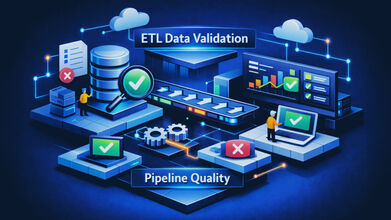
ETL Data Validation: A Complete Guide to Pipeline Quality
Data pipelines move fast. Bad data moves just as fast, and it rarely announces itself. A transformation error introduced at extraction doesn't stop the job. It rides quietly through every stage until it surfaces as a wrong number in a revenue report or a missing segment in a customer dashboard, usually at the worst possible moment.
ETL data validation is the practice of verifying that data meets defined quality rules at each stage of the pipeline: after extraction, after transformation, and after load. It's not a single check at the end. It's a continuous set of assertions built into how the pipeline runs. Without it, errors compound silently, and by the time they're visible, tracing them back to their origin is expensive and slow.
This guide covers the SQL checks that matter, how to reconcile source to target, detect schema drift, and automate through CI/CD, along with how to choose the right tooling. Platforms like QuerySurge exist specifically to automate this work at enterprise scale, closing the gap between pipeline execution and error discovery. Start with what ETL data validation actually covers.
What ETL Validation Actually Covers
Most teams conflate validation with testing, and both suffer for it. ETL testing verifies that pipeline logic works correctly: it's event-driven, code-centric, and typically runs on deployment. Validation is different. It's continuous and data-centric, checking whether the data itself meets defined expectations at each stage; both are necessary, but this article focuses on the data side.
There are three natural checkpoints in any pipeline. Post-extraction validation asks whether the source data matches expectations before any transformation occurs. Post-transformation validation confirms that business logic applied correctly. Post-load validation verifies that everything landed in the target as intended. Running checks only at the end is one of the most common mistakes in pipeline design. Errors caught late are exponentially more expensive to diagnose.
The cost ultimately lands on downstream systems. Incorrect aggregates in a financial report, missing records in a customer dashboard, duplicate rows in an analytics model, all these trace back to skipped validation upstream. The closer a bad record gets to an end user, the harder it is to trace back to its origin.
ETL Data Validation: Core Quality Checks Every Pipeline Needs
Row count matching is the most fundamental check. Compare COUNT(*) from source against COUNT(*) in the target and flag any mismatch. It's simple, but don't stop there. A passing row count with high null rates in critical fields still signals a broken pipeline. Check non-null population rates for mandatory columns alongside row counts, not separately.
Null and Range Checks
Null threshold checks the percentage of null values per column and fail when rates exceed a defined tolerance. Range validation catches numeric fields outside acceptable bounds, for example, order_price <= 0 or dates outside an expected window. Together, these two checks eliminate a large share of transformation errors before they reach downstream consumers.
Format Validation and Duplicate Detection
Format validation uses regex patterns to verify that structured fields such as email addresses, phone numbers, or customer identifiers match the expected shape. Duplicate detection uses a simple GROUP BY with HAVING COUNT(*) > 1 on primary key columns. Referential integrity goes further: a NOT EXISTS subquery verifies that foreign key values in the target actually exist in the referenced master table. These checks protect the relational consistency that every downstream join assumes.
Aggregate Comparisons
Aggregate comparisons are the validation layer most teams skip, and they catch transformation logic errors that row counts never will. A UNION ALL pattern comparing SUM , AVG, MIN, and MAX between source and target tables will surface a mismatched revenue total even when row counts match exactly. That scenario is a data accuracy failure, not a completeness failure, and it's invisible without this check.
Source-to-Target Reconciliation: Closing the Accuracy Loop
Reconciliation is not the same as row count validation. Field-level reconciliation compares individual column values between source and target. Aggregate reconciliation compares totals within defined tolerance thresholds, such as a SUM within 0.01%. For smaller datasets or high-stakes columns, such as financial figures, field-level matching is the right approach. For large-volume batch jobs where exact matching is impractical, aggregate tolerance windows are acceptable, but tolerance thresholds should reflect the risk level of the data, not a default setting.
Best practice is to validate after each stage, not just at load. Catching a null injection error after transformation costs minutes. Finding a mismatched aggregate in the target warehouse days later costs hours of investigation and eroded trust in the data. Build reconciliation checkpoints into the pipeline definition itself as first-class steps, not as post-load audits.
Source-to-target mapping documents are not just design artifacts. They define the expected behavior of every transformation and serve as the specification from which validation rules are derived. Teams that treat mappings as living documents, updated whenever logic changes, can auto-generate test cases directly from them. This is where a platform like QuerySurge provides genuine leverage: its AI-powered Mapping Intelligence connects to Excel mapping documents, extracts source-to-target mappings, and automatically converts them into executable test suites, processing hundreds of mappings in a fraction of the time manual creation requires.
Handling Schema Drift Before It Becomes a Production Problem
Schema drift happens when source systems change column names, data types, or nullable constraints without notifying downstream teams. Unlike hard failures, drift often produces data that loads successfully but is semantically wrong. Renaming a column from cust_id to customer_id won't break extraction. It will break every join downstream, silently, until someone notices the numbers are wrong.
The practical fix is schema validation as a first-class pipeline step, not a warning. Compare the incoming schema against a registered baseline at extraction time. Flag type mismatches, added or dropped columns, and changed nullability. Treat schema validation failures as pipeline-halting events. A pipeline that loads wrong data is worse than a pipeline that stops.
Schema drift is an ongoing operational risk, not a one-time event. Configure monitoring to compare schema snapshots across pipeline runs and alert on deviations immediately. Pair this with version-controlled pipeline definitions so teams can trace exactly when a drift was introduced and which pipeline run was first affected. In teams without dedicated schema monitoring, schema-related failures routinely account for a disproportionate share of debugging time, catching drift at ingestion eliminates most of that cost.
ETL Data Validation in CI/CD Pipelines
Both Airflow and Dagster support embedding data quality checks directly into pipeline execution. In Airflow, validation runs as dedicated tasks within DAGs, using custom operators or integrations with tools like Great Expectations. In Dagster, asset-centric definitions attach quality checks directly to data assets with built-in lineage tracking. Dagster includes native testing infrastructure; Airflow requires more manual setup but gives teams full flexibility in how checks are structured.
Validation should block deployments when checks fail, not just log warnings. In a CI/CD setup, data quality gates run automatically on every pipeline change. A failed row count or referential integrity check prevents the pipeline from being promoted to production. This applies the same principle as a failing unit test blocking a code merge, applied to data. When validation is integrated this way, every pipeline change is tested against the full suite before it can affect production data.
QuerySurge's RESTful API with 60+ API calls integrates natively with any CI/CD pipeline, allowing teams to trigger complete data validation test suites as part of automated deployments. For enterprise teams managing hundreds of tables across dozens of data sources, this eliminates the manual validation bottleneck that typically gates releases. See Issues Moving Validation Into DataOps CI/CD Pipelines | QuerySurge for practical guidance on embedding validation into pipeline CI/CD flows. Every change runs through automated ETL tests before it reaches production, and failures surface immediately rather than days later in a report.
Monitoring Pipeline Health and Choosing the Right Tools
The metrics worth tracking are specific. Error rate should stay below 0.1%. Data completeness should exceed 99.5%. Data freshness measures latency against the defined SLA window. Row count deviation flags when current volumes fall outside historical averages.
Set multi-tier alerting: warning at 80% of SLA, critical at 95%. Tying mean time to detection directly to alert thresholds is what keeps MTTD in minutes rather than hours. Without automated threshold alerts, many data teams go hours before detecting a pipeline failure, by which point downstream reports have already consumed bad data.
Open-source tools cover specific layers well but rarely span the full pipeline end-to-end. Great Expectations offers flexible expectation-based validation but requires significant coding and setup investment. dbt tests integrate cleanly into ELT workflows but are warehouse-dependent and don't cover the extraction stage. Deequ scales well in Spark environments but is limited to that ecosystem. For additional perspectives on common approaches to validation and tooling, see resources on data quality checks in ETL. Each tool is strong in its domain; none of them covers ETL data validation, BI report testing, and CI/CD data quality gates together without substantial integration work between them.
For enterprise teams with 200+ data sources, complex transformation logic, and downstream BI reporting, a purpose-built platform addresses what open-source tools leave exposed. QuerySurge automates test creation from data mappings, validates across cloud and on-premises sources, supports no-code test generation with AI, and provides audit dashboards with built-in root cause analysis. It connects pipeline validation, BI report testing, and CI/CD data quality gates in a single platform, rather than requiring separate tools stitched together for each layer. For a deeper technical case study, see A Comprehensive Analysis of Automated Validation of Snowflake.
Build Validation Into How Pipelines Run, Not After
The strategy is straightforward: define checks at each pipeline stage, reconcile source to target at every step, embed schema-drift detection at ingestion, automate with CI/CD, and monitor with SLA metrics that trigger alerts before users notice problems. None of these practices require a major infrastructure overhaul to start. Most teams begin with row count matching and null checks, then expand to aggregate comparisons and referential integrity as their validation maturity grows.
ETL data validation is not a project with a finish line. It's a continuous practice built into how pipelines run. The teams that treat it as a first-class engineering concern rather than a post-deployment audit have shorter debugging cycles, higher confidence in their data, and faster releases. The teams that skip it spend that time responding to incidents instead.
Manual SQL scripts get you started. At enterprise scale, with hundreds of tables, multiple data sources, and BI reports that depend on accurate downstream data, the maintenance cost of manual validation outgrows the team's capacity to sustain it. QuerySurge is built for that transition: from manual scripts to automated, AI-powered validation that runs continuously across your entire data ecosystem. If your pipelines have outgrown manual checks, see our 4-Part Series on Automating your Data Validation & ETL to learn practical next steps and implementation patterns at scale.