White Paper:
Best QuerySurge Alternatives
for Data Testing in 2026
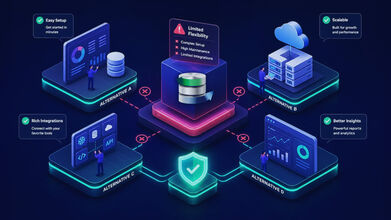
Many teams searching for QuerySurge alternatives aren't abandoning data testing discipline. They're evaluating specific trade-offs: a budget ceiling that doesn't support enterprise licensing, a narrower use case that doesn't require full-platform coverage, or a stack configuration where one tool's connector depth matters more than another's. QuerySurge is a widely used benchmark in enterprise ETL and BI testing, and that's the frame this article uses. What follows is a direct comparison of the top five alternatives, how each stacks up on integrations and pricing, and a decision framework to help you shortlist two or three serious candidates before you schedule a single demo.
The goal isn't to steer you toward a particular vendor. It's to give you an accurate enough picture of each tool that you can self-select based on your environment.
Why teams explore alternatives to QuerySurge
Teams that evaluate other data testing platforms are not walking away from rigorous validation. They're navigating a mismatch between platform scope and current needs. The honest reasons come down to a few recurring patterns: licensing cost at enterprise scale, a learning curve that slows adoption for less technical users, or an interest in observability-first workflows rather than active test execution.
When the scope doesn't match the platform
A single-warehouse team running a relatively simple ETL pipeline doesn't need the same automation depth as a global financial services firm managing dozens of data sources and nightly BI delivery. Enterprise-grade platforms are built for the latter. When a team's actual scope is narrower, the overhead of a full-featured platform, setup complexity, licensing structure, and ongoing maintenance can outweigh the benefits. Smaller engineering teams in that situation often look for data testing tools that trade some coverage for faster time-to-value
The rise of observability-first competitors
A distinct category of tools entered the market with a fundamentally different philosophy. Platforms like Monte Carlo don't execute scripted tests at pipeline checkpoints. They monitor the data environment continuously, using machine learning to detect anomalies and flag broken pipelines before downstream systems surface the damage. For teams that want passive monitoring rather than active test execution, that distinction matters. The trade-off is real: observability covers unknown failures well, but it doesn't replace structured data validation software for complex transformation logic
The top QuerySurge alternatives worth evaluating
These five tools represent the serious options across two categories: active test execution and observability-led monitoring. Each has a genuine use case. None of them is a universal replacement for a purpose-built ETL and BI testing platform, but each covers real ground for the right team.
Monte Carlo: observability over execution
Monte Carlo is the most prominent data observability platform in this space. It monitors your entire data stack in real time, learns normal data patterns through machine learning, and alerts teams to anomalies before they become downstream incidents. The alert quality is notably better than traditional rule-based tools: instead of noisy threshold violations, Monte Carlo surfaces issues with lineage context so engineers can trace root causes quickly. The limitation is structural. Monte Carlo does not replace active ETL test execution. If you need to validate specific transformation logic, column-level data accuracy, or source-to-target reconciliation, observability alone won't cover that. It works best as a complement to structured testing, not a substitute.
Datagaps DataOps Suite: automation with GenAI assistance
Datagaps ETL Validator is purpose-built for data pipeline test automation and has been recognized by Gartner as a specialist in that category. Its Spark-based engine handles enterprise data volumes, and its GenAI-assisted rule authoring lets teams generate and maintain test rules without deep SQL expertise. The synthetic test data generation capability is genuinely useful for teams that can't run tests against production data copies. It also supports cross-pipeline orchestration, running tests across multiple pipelines in a single execution. Native CI/CD integrations include Jenkins and GitHub, plus a broad library of additional plugins for other toolchain components. For ETL-heavy environments with senior data engineers who want automation depth without excessive manual rule maintenance, Datagaps is a credible option among ETL testing tools.
iceDQ: unified reliability across the data stack
iceDQ takes a broad approach. It covers ETL testing, big data lake testing, BI report testing, and data migration testing within a single platform. It layers AI-based observability on top of active test execution, which gives it more coverage than tools that pick one approach. The platform has a smaller user review footprint than some alternatives, which makes third-party validation harder to source. Initial setup complexity and documentation gaps are the most commonly cited friction points from users who have reviewed it on sites like G2 and Capterra. For teams that want a single tool across multiple testing disciplines and are willing to invest in onboarding, iceDQ is worth a proof-of-concept evaluation.
Tricentis Data Integrity and Talend: enterprise validation with low-code appeal
Both Tricentis Data Integrity and Talend Data Quality target enterprise data quality teams with mixed technical skill levels. They offer pre-built rule libraries, low-code rule builders, and support for structured and semi-structured data formats including JSON and XML. Tricentis adds bi-directional synchronization testing, which matters for teams validating data flows in both directions across integrated systems. Talend leans into integration breadth and API-based testing flexibility. Neither tool is primarily designed for ETL regression automation at scale; they're stronger in data quality governance and rule-based validation workflows. If your team needs a low-code interface for business analysts alongside technical validation for engineers, either platform fits that profile.
How to evaluate QuerySurge alternatives by integration depth
After "does this tool do what I need," the next question is always "will it connect to my stack." For data warehouse testing tools, that means verifying connector depth against your cloud warehouses, not just confirming that a connector exists.
Cloud warehouse and lakehouse support
Snowflake, Databricks, Fabric, BigQuery, Redshift, and Oracle ADW are the top 6 data warehouse/lake targets most enterprise teams need to validate. Connector quality varies significantly across tools. Some platforms support open table formats like Apache Iceberg, which provides compatibility with both Snowflake and Databricks on multicloud stacks. Others rely on vendor-specific connectors that may have limitations around query pushdown, schema drift detection, or performance at scale. The right question isn't whether a connector is listed: it's whether the connector handles your actual query patterns and data volumes without degrading test execution speed. For a practical view of available connectors, consult resources that list the top Snowflake connectors for ETL use cases, and compare them against broader platform comparisons such as a comparison of BigQuery, Redshift, Snowflake, and Databricks.
CI/CD compatibility and API surface
Genuine CI/CD integration requires a RESTful API with meaningful coverage, webhook support, and documented compatibility with Jenkins, GitHub Actions, and Azure DevOps. Some tools advertise CI/CD support but require significant custom scripting to make test execution function inside an automated pipeline. Before committing to any platform, ask for a working integration example with your specific CI toolchain. The difference between "we support REST API" and "here's a working GitHub Actions workflow" reveals a lot about how mature the integration actually is. Datagaps, for instance, ships native Jenkins and GitHub integrations that demonstrate this kind of production-ready ETL automation testing depth. If you're evaluating Snowflake-specific ETL toolchains as part of that CI/CD check, see vendor overviews like Snowflake ETL tools for context on common integration patterns.
Pricing models you'll encounter across these platforms
Most enterprise data testing tools don't publish pricing. That's not evasion; it reflects the reality that cost at scale depends on factors that require a scoped conversation: data source count, user seats, test run volume, and support tier. Going into vendor conversations with a clear mental model helps you ask better questions.
SaaS tiers versus perpetual licenses
SaaS-delivered tools offer predictable monthly or annual fees that scale by seat count, data source connections, or test execution volume. On-premises tools carry large upfront perpetual license fees plus annual maintenance costs, typically 15 to 20 percent of the license price, covering updates and support. Neither model is inherently better. The right choice depends on your organization's CapEx versus OpEx preferences and whether your IT governance requires on-premises deployment. If you're evaluating both, model total cost of ownership over three years, not just year-one spend. For a primer on typical approaches, review modern SaaS pricing models to see how vendors commonly tier features, seats, and usage.
What enterprise pricing actually means in practice
At enterprise scale, pricing moves to custom quotes. The variables that drive negotiation include the number of integrated data sources, pipeline complexity, support SLA tier, and professional services scope for implementation. Before you sign anything, request a scoped proof-of-concept that reflects your actual environment. A tool that performs well in a vendor-controlled demo may behave differently against your specific data volumes and transformation complexity.
How to match the right tool to your environment
The goal of this section is to help you go from five options to two or three serious candidates. Four variables do most of the work: team technical level, data stack complexity, integration requirements, and primary testing discipline.
Comparing QuerySurge alternatives by use case and team profile
ETL-heavy pipelines with senior data engineers often find the most value in Datagaps or iceDQ, both of which offer automation depth and pipeline orchestration. Observability-first teams with lean DataOps setups will find Monte Carlo's passive monitoring model a strong fit, particularly when pairing it with an active testing tool for transformation validation. Mixed technical teams that need business analysts and engineers working in the same platform should evaluate Tricentis or Talend. Teams that need full-stack coverage across ETL, BI report validation, and data migration testing should evaluate platforms that consolidate those disciplines rather than stitching three separate tools together. For a side-by-side perspective, see QuerySurge's own competitive analysis of how the platform compares across common enterprise requirements.
Three questions to ask before a demo or trial
First: how does the tool handle schema drift across environments? Schema changes break tests, and the answer reveals how much ongoing maintenance the platform requires. Second: what does CI/CD integration look like in practice, and can the vendor show a working example with your CI toolchain? Third: what is the support model and response time SLA at your contract tier? Feature checklists look similar across vendors. The answers to these three questions don't.
Where QuerySurge still has the edge
Every alternative above covers real ground, but each covers a subset of what a full ETL and BI data testing platform delivers. Monte Carlo excels at observability but doesn't execute structured transformation tests. Datagaps is strong on ETL automation but narrower on BI and migration coverage. iceDQ covers multiple disciplines but carries higher onboarding friction. Tricentis and Talend serve mixed technical teams well but aren't built for ETL regression automation at enterprise scale.
Purpose-built for ETL and BI validation at enterprise scale
QuerySurge covers ETL testing, BI report validation, data migration testing, and big data testing from a single platform with a broad library of integrated data source connectors. That breadth matters for enterprise teams that don't want to manage multiple vendor relationships, reconcile gaps between tools, or accept reduced coverage in one discipline to gain strength in another. For large organizations operating at that scale, the consolidation alone carries measurable operational value by reducing toolchain overhead and support complexity. You can also review the platform slide deck titled QuerySurge, the automated Data Testing solution, for a concise overview of features and coverage.
AI-powered test generation as a practical differentiator
QuerySurge's ability to bulk-convert data mappings into executable tests significantly reduces the SQL expertise barrier without sacrificing test precision. That combination, no-code accessibility layered on enterprise-grade automation isn't common across the alternatives in this list. Before committing to a narrower tool or a multi-tool stack, a QuerySurge proof-of-concept against your actual environment will clarify whether the gap is real.
The bottom line on selecting a data quality testing platform
When evaluating QuerySurge alternatives, the right answer comes down to fit: fit between the tool's design and your team's technical level, your stack's complexity, and the testing disciplines you actually need to cover.
Observability-first teams with lean setups should evaluate Monte Carlo. Automation-focused engineering teams should look closely at Datagaps or iceDQ as ETL testing tools with solid pipeline orchestration. Mixed technical teams with low-code requirements fit Tricentis or Talend. Teams that need full-stack ETL, BI, and migration testing coverage in a single data quality testing platform, with AI-assisted test generation and a deep connector library, should put QuerySurge at the top of their shortlist rather than assembling the same coverage from multiple tools.
If you haven't yet run a scoped proof-of-concept, that's the next step. A structured trial against your actual data stack will answer every question a feature comparison can't. Request a QuerySurge demo and see the full platform against your environment before you decide