QuerySurge + Microsoft Fabric
Validate data across Microsoft Fabric,
from source systems and OneLake to Power BI
Why QuerySurge + Fabric
Fabric simplifies how organizations ingest, store, transform, analyze, and visualize data. But a unified platform does not eliminate the risk of bad data. Errors can still enter at the source, occur during transformation, or appear in semantic models and reports.
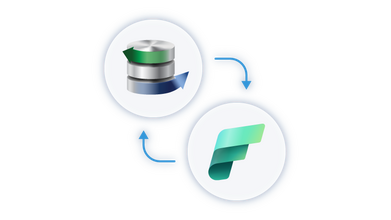
QuerySurge adds an independent, automated validation layer across the Fabric data lifecycle.
It compares expected and actual data, verifies transformation and business rules, and provides clear evidence that data is ready to move downstream.
- Validate migrations into Fabric from legacy databases, cloud platforms, files, and enterprise applications.
- Test data as it moves through Data Factory pipelines and into OneLake, lakehouses, or warehouses.
- Verify SQL, Spark, Power Query, DAX, joins, filters, calculations, and aggregations.
- Confirm that Power BI semantic models and report outputs agree with trusted source data.
- Turn repeatable tests into automated quality gates within DataOps and CI/CD workflows.
How QuerySurge + Fabric Works
QuerySurge connects the checkpoints across your Fabric architecture, then continuously tests the data between them.
Connect across the data flow
Connect QuerySurge to source systems and to the Fabric endpoints and data storesused by your solution, including SQL-accessible warehouses and lakehouses, OneLake data files, and Power BI.Create reusable validation tests
Use QuerySurge QueryPairs and Smart Wizards to compare source-to-target, stage-to-warehouse, lakehouse-to-semantic-model, or report-to-source results. Define checks for reconciliation, transformation logic, completeness, duplicates, schema changes, and business rules.Execute at the right point in the pipeline
Run tests on demand, on a schedule, or automatically from orchestration and CI/CD processes. Validate after ingestion, transformation, deployment, refresh, or migration cutover.Analyze differences quickly
QuerySurge identifies mismatched rows and cells, missing or unexpected data, and failed thresholds so teams can isolate where a defect entered the flow.Promote only trusted data
Use results as a quality gate before data advances to downstream layers, Power BI, AI workloads, or production. Dashboards, notifications, and test history provide traceability for technical and business stakeholders.
Key Benefits
Build confidence into Fabric delivery without relying on manual reconciliation, one-off scripts, or problems discovered after reports reach the business.
Reduce migration and modernization risk |
Reconcile legacy sources with Fabric targets and catch missing, duplicated, truncated, or incorrectly transformed data before cutover. |
Test the full data journey |
Replace repetitive manual checks with reusable tests that can run continuously as pipelines, models, and reports change. |
Accelerate delivery through automation |
Replace repetitive manual checks with reusable tests that can run continuously as pipelines, models, and reports change. |
Detect defects earlier |
Find data problems close to where they are introduced, reducing downstream troubleshooting, rework, and business disruption. |
Strengthen governance with evidence |
Create consistent, repeatable validation results and historical records that support auditability, controls, and accountability. |
Improve confidence in analytics and AI |
Help ensure that dashboards, decisions, and AI workloads are built on data that has been independently tested against expected results. |
Ready to Trust Your Microsoft Fabric Data?
Continuously automate testing, accelerate releases, and gain confidence in every dataset.