QuerySurge Validation Lineage
See the connections. Understand the impact.
Test with confidence.

QuerySurge Validation Lineage visually connects your data mappings and testing assets, helping you trace dependencies, identify coverage gaps, and focus testing where it matters.
The Challenge:
Understanding What a Change in Data Transformation Logic Affects
When data transformation logic changes, your team needs to know which tests require attention.
But connections between mappings, queries, test suites, and schedules aren’t always easy to follow. Tracing those dependencies manually takes time and makes it harder to determine what needs updating and retesting.
The Risk:
Missed Tests and Undetected Data Errors
Without clear visibility into dependencies, teams can overlook affected tests or miss requirements that lack validation coverage.
As ETL/ELT processes evolve, testing can fall out of step with documented requirements, increasing the risk that data errors reach reports, analytics, and business decisions.
The Solution:
QuerySurge Validation Lineage
Validation Lineage connects your data requirements and testing assets, so your team can understand the impact of change, identify coverage gaps, and focus testing where it matters.
An interactive lineage graph lets you explore upstream and downstream dependencies beyond an asset’s immediate relationships.
- Connect requirements to validation. Define relationships between mappings, QueryPairs, and Staging Queries.
- Follow testing dependencies. Explore connections that QuerySurge automatically identifies through the use of reusable query snippets, QueryPairs, test suites, and recurring schedules.
- Assess change impact. Identify connected assets that may need review before updating and rerunning tests.
- Review validation coverage. Use coverage reports to see which mappings have associated tests and which need attention.
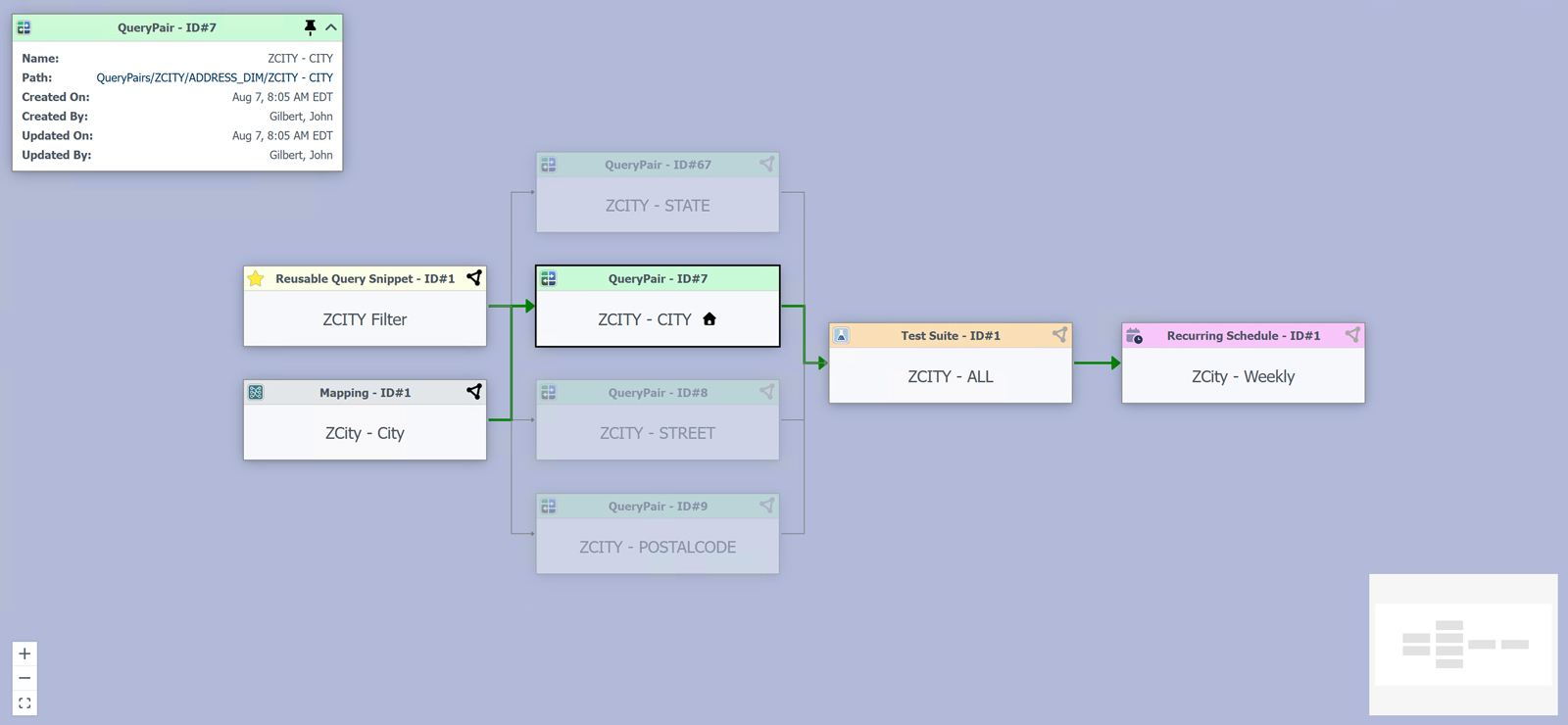
See the connections. Understand the impact. Test with confidence.
QuerySurge Validation Lineage visually connects your data mappings and testing assets, helping you trace dependencies, identify coverage gaps, and focus testing where it matters.

Frequently Asked Questions
- What is Validation Lineage?
- What's the difference between data lineage and Validation Lineage?
- Does Validation Lineage replace my data lineage or data catalog tool?
- What problem does Validation Lineage solve?
- Who uses Validation Lineage?
- What assets does Validation Lineage connect?
- Do I have to define every relationship by hand?
- How far does the lineage graph go?
- How does Validation Lineage help when transformation logic changes?
- How do I find requirements that have no tests?
- Can Validation Lineage help us prioritize testing?
- How does Validation Lineage support audit and governance?
- How does Validation Lineage work with Mapping Studio?
- Do I need Mapping Studio to use Validation Lineage?
- Which version of QuerySurge includes Validation Lineage?
- Is Validation Lineage an additional cost?
Validation Lineage is a QuerySurge capability that maps how your data requirements connect to the tests that validate them. An interactive graph shows the relationships between mappings, QueryPairs, Staging Queries, test suites, and schedules, so your team can see what's tested, what isn't, and what a change will affect.
Data lineage tracks the data itself: where it came from, which systems it passed through, and how it was transformed along the way. Validation Lineage tracks how your data is tested: which requirements have tests, how those tests connect to suites and schedules, and which tests are affected when logic changes. Data lineage tells you how data got here. Validation Lineage tells you whether it was proven correct along the way, and what needs retesting when something changes.
No. They do different jobs and work well together. Your lineage or catalog tool shows how data flows across systems. Validation Lineage shows how that data is validated. Used together, they give you both the map and the proof.
When transformation logic changes, teams need to know which tests require attention. Without visibility into dependencies, they trace connections by hand across mappings, queries, suites, and schedules. That's slow, and it's easy to miss an affected test or a requirement that was never tested at all.
QA and test leads planning retesting after a change, data engineers updating transformation logic, and data governance teams who need evidence that requirements are covered by tests.
Mappings, QueryPairs, Staging Queries, reusable query snippets, test suites, and recurring schedules.
No. You define the relationships between mappings, QueryPairs, and Staging Queries. QuerySurge identifies the rest automatically through the use of reusable query snippets, QueryPairs, test suites, and schedules.
Beyond an asset's immediate relationships. You can follow dependencies upstream and downstream through the full chain, from a mapping to its queries, to the suites that contain them, to the schedules that run them.
Start from the mapping or query that changed and see every connected asset that may need review. Your team knows exactly what to update and rerun before the next pipeline run, instead of guessing or retesting everything.
Coverage reports show which mappings have associated tests and which need attention. Those gaps can then be closed with tests generated by QuerySurge AI: Mapping Intelligence.
Yes. Seeing which assets a change touches lets your team focus testing effort where the risk is, instead of rerunning entire suites by default.
It gives you a traceable line from documented requirements to the tests that validate it, plus coverage reports showing what's tested. That's evidence auditors and governance teams can review, which supports compliance with SOX, HIPAA, GDPR, and 21 CFR Part 11.
Mapping Studio is where your mapping requirements live and get turned into tests. Validation Lineage shows how those mappings connect to tests, suites, and schedules over time. One documents what the data should do. The other shows how well it's being tested.
[Needs product confirmation]
Validation Lineage is new in QuerySurge 15.
No. Validation Lineage is included with every paid QuerySurge license, as well as Mapping Studio and QuerySurge AI. See Licensing & Pricing for package details.