Whitepaper
Enterprise Guide to
ETL Testing Tools in 2026
Published by Bill Hayduk, CEO, RTTS
Introduction
Before comparing tools, it’s worth making a distinction that too many organizations miss:
ETL tools move and transform data: Fivetran, dbt, Airbyte, Azure Data Factory, and AWS Glue are ETL tools.
ETL testing tools validate that the data ETL tools produce is accurate, complete, and trustworthy: QuerySurge, iCEDQ, Great Expectations, and dbt Tests are ETL testing tools.
These are different categories solving different problems. Choosing an ETL tool does not solve your data validation challenge.
In 2026, the era of manual ETL validation – exporting CSVs, performing row counts in Excel, or running ad-hoc SQL queries is officially over. The volume, velocity, and complexity of modern data pipelines demand automated, continuous, enterprise-grade validation.
This guide covers the ETL testing tool landscape in 2026 and helps enterprise data teams find the right fit for their needs.
What to Look for in an ETL Testing Tool in 2026
The right ETL testing tool for your organization depends on your environment, team, and requirements. The nine criteria that matter most for enterprise data teams:
- Core ETL testing capabilities: Can the tool validate data completeness, accuracy, transformation logic, and business rules across source and target systems?
- Pipeline coverage: Does the tool validate data at every stage – source, transformation, warehouse, BI reports, and AI model inputs – or only at specific points?
- AI-powered test generation: Can the tool generate tests automatically from data mappings or plain English prompts, reducing manual test creation effort?
- CI/CD and DevOps integration: Can the tool be embedded as a data quality gate in your existing CI/CD pipelines?
- No-code and low-code accessibility: Can non-technical team members build and run tests without SQL or coding expertise?
- Enterprise deployment flexibility: Does the tool support on-premise, cloud, and hybrid deployment for organizations with strict security or data residency requirements?
- Audit and compliance documentation: Does the tool produce audit-ready reports that satisfy SOX, HIPAA, GDPR, and other regulatory requirements?
- Connector breadth: How many data sources, platforms, and BI tools does the tool connect to natively?
- Scalability: Can the tool validate billions of records at enterprise scale without performance degradation?
The ETL Testing Tool Landscape in 2026
ETL testing tools broadly fall into three categories:
Purpose-built ETL testing platforms. Commercial tools designed specifically for automated data validation across enterprise pipelines. Most mature, deepest capabilities, broadest connectivity.
Open-source data quality frameworks. Community-driven frameworks like Great Expectations and dbt Tests. Flexible and free but require significant engineering investment to implement and maintain at enterprise scale.
Embedded testing within ETL platforms. Some ETL platforms (Integrate.io, Fivetran + dbt) include basic data quality and observability features. Convenient but typically not purpose-built for comprehensive data validation.
Purpose-Built ETL Testing Platforms
QuerySurge – Best for Enterprise Data Validation
QuerySurge is the most mature purpose-built automated data validation and ETL testing platform available, with over two decades of enterprise deployment experience across Fortune 500 and Global 2000 organizations.
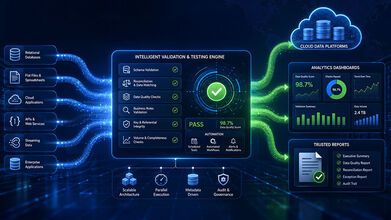
What it does: QuerySurge validates data accuracy at every stage of the pipeline – from source systems through ETL/ELT transformations, data warehouses, data lakes, BI reports, and AI model inputs. Unlike tools that test only ETL pipelines, QuerySurge covers the full data journey.
Key capabilities:
- Mapping Intelligence – auto-generates complete test suites from data mapping documents, converting thousands of mappings into automated tests immediately
- Query Intelligence – a chat interface where users describe tests in plain English; QuerySurge analyzes schema metadata and generates ready-to-run SQL in the native language of your source and target systems
- BI Tester – validates data inside Power BI, Tableau, Oracle BI, SAP Business Objects, and StrategyB down to cell level
- DevOps for Data – 100+ API actions for native CI/CD integration with Jenkins, Azure DevOps, GitHub Actions, Bamboo, GitLab, many others
- 200+ connectors – Snowflake, Databricks, Microsoft Fabric, BigQuery, Redshift, Oracle ADW, DynamoDB, all major BI platforms, and all types of files
- Audit-ready compliance – full audit trails, lineage-aware validation, exportable compliance reports for SOX, HIPAA, GDPR, BCBS 239, CFR Part 11, others
- Deployment – on-premise, cloud, and hybrid; available in Azure and AWS marketplaces
Best for: Enterprise organizations with complex, multi-platform data environments requiring full pipeline coverage, BI validation, compliance documentation, and deep DevOps integration.
Notable customers: Fortune 500 organizations including Coca-Cola Consolidated across financial services, healthcare, insurance, technology, retail, and government.
iCEDQ – On-Premise Limitations Worth Noting
iCEDQ offers automated ETL testing, data quality monitoring, and data migration testing capabilities with a unified testing and monitoring approach.
Key capabilities:
- ETL testing, data migration testing, and BI report testing
- Big Data Edition for Hadoop and large-scale environments
- Unified testing and monitoring in one platform
Considerations: The on-premise version of iCEDQ lacks several core ETL testing capabilities that enterprise teams typically require. The SaaS version is more feature-complete but not suited for teams that need on-premise deployment. User reviews also note performance issues and lack of API connectivity as limitations.
Best for: Organizations with straightforward ETL testing needs that are comfortable with SaaS-only deployment.
Tricentis Data Integrity – Software Testing Heritage, Newer Data Play
Tricentis – primarily known as an enterprise software testing platform, launched Tricentis Data Integrity as its entry into the data validation space. They position it as continuous data testing that goes beyond what data quality and observability tools provide.
Key capabilities:
- Continuous data testing integrated with Tricentis’s broader quality engineering platform
- Cloud deployment available in 2026
- Strong integration with Tricentis’ purpose-built data validation depth is less mature than that of existing software testing ecosystem
Considerations: Data Integrity is a newer product from a software testing company entering the data validation space. Organizations already using Tricentis for software testing may find value in consolidation, but purpose-built data validation depth is less mature than dedicated platforms.
Best for: Organizations already using Tricentis for software testing who want to consolidate vendors.
Datagaps ETL Validator – Full Lifecycle Claims, Newer AI Capabilities
Datagaps positions itself as a full data lifecycle platform, covering ingestion through ETL, data quality, BI validation, and AI model input testing from a single system.
Key capabilities:
- Agentic AI with self-healing tests via an embedded LLM running locally
- Informatica certified with SOC 2 Type II certification
- BI validation and data observability modules
- US-patented validation methodology
- Gartner recognition in DataOps Tools and Data Observability market guides
Considerations: Datagaps’ AI capabilities are newer and have a less proven track record in enterprise than others. DataGaps has invested in broadening its platform capabilities, positioning itself as a full data lifecycle solution that covers everything from ingestion to AI model validation. But breadth of claims is not the same as depth of capability and they may be spread too thin.
Best for: Organizations evaluating a broad suite that includes data movement alongside validation.
Open-Source Data Quality Frameworks
Great Expectations – Flexible but Engineering-Heavy
Great Expectations is one of the most widely used open-source data quality frameworks, now stewarded by Fivetran following their acquisition of dbt Labs.
Key capabilities:
- Python-native data validation framework
- Flexible, customizable expectations for data quality checks
- Strong community and documentation
- Integrates with dbt, Airflow, and major data platforms
Considerations: Great Expectations requires significant Python engineering expertise to implement and maintain. It is not a no-code or low-code solution. At enterprise scale, the investment in building, maintaining, and scaling a Great Expectations implementation can exceed the cost of a purpose-built platform. Audit documentation and compliance reporting require custom development.
Best for: Data engineering teams with strong Python expertise who prefer open-source flexibility and are willing to invest in implementation and maintenance.
dbt Tests – Transformation-Layer Validation
dbt’s native testing capabilities allow data teams to define and run tests on transformed data within their dbt project.
Key capabilities:
- Schema tests (not null, unique, accepted values, relationships)
- Custom SQL tests for business logic validation
- Integrated with dbt Cloud and dbt Core workflows
- Native to the dbt transformation layer
Considerations: dbt Tests validate data within the transformation layer – they do not cover source-to-target validation, BI report validation, or the full pipeline from source through warehouse to BI output. Only 24% of data teams prioritize AI-assisted pipeline management including testing and observability, suggesting dbt Tests alone are insufficient for organizations serious about comprehensive data quality.
Best for: dbt-native data teams looking for lightweight validation within their transformation workflow, not a replacement for full pipeline data validation.
Embedded Testing within ETL Platforms
Several ETL and data integration platforms include basic data quality and observability features:
Integrate.io – positions itself as the optimal choice for organizations seeking built-in ETL testing capabilities within a complete data integration platform, with data observability, automated alerting, and quality monitoring. Convenient for teams already using Integrate.io but less comprehensive than purpose-built validation platforms.
Fivetran + dbt Labs – The merged entity offers data movement, transformation, and basic quality checks in one platform. Positions as the data infrastructure for trusted AI agents. Pipeline-level quality checks but not purpose-built for comprehensive source-to-target validation, BI testing, or compliance documentation.
How to Choose the Right ETL Testing Tool for Your Organization
Use this decision framework based on your organization’s priorities:
Choose a purpose-built platform (like QuerySurge) if:
- You need full pipeline coverage – source through ETL, warehouse, BI reports, and AI inputs
- Compliance and audit documentation are required (SOX, HIPAA, GDPR)
- You need BI report validation down to cell level
- On-premise deployment is required for security or data residency
- You need 200+ native connectors across a multi-platform environment
- DevOps integration is a requirement
- AI-generated test creation from mappings or plain English is important
Choose an open-source framework (like Great Expectations or dbt Tests) if:
- You have strong Python engineering expertise in-house
- You are comfortable with implementation and ongoing maintenance investment
- Budget is the primary constraint
- Your validation needs are primarily within the transformation layer
Choose embedded testing (Integrate.io, Fivetran + dbt) if:
- You are already using that platform for data movement
- Your validation needs are basic – completeness and freshness checks
- You are early in your data quality journey
The Bottom Line
In 2026, the question is no longer whether to automate ETL testing – it’s which approach matches your organization’s scale, complexity, and compliance requirements.
The cost of a data defect multiplies at every stage it travels downstream. Caught at the source, it takes minutes to fix. Caught in a BI report, it takes weeks. Caught by a business user after it has already driven decisions – it takes months of damage, rework, and lost trust that is harder to rebuild than the defect was to create.
For enterprise organizations with complex, multi-platform data environments where accuracy, compliance, and audit readiness are non-negotiable – a purpose-built, dedicated data validation platform remains the right answer.
The platforms that move your data are getting smarter every quarter. Make sure someone is independently proving that what they’re moving is actually correct.
QuerySurge is the enterprise standard for automated data validation – validating data across 200+ sources from source through ETL, warehouse, BI reports, and AI model inputs.
Request a QuerySurge Demo | See How QuerySurge Compares | View All 200+ Integrations